The Industries Driving America’s Next Wave of Economic Growth

The American economy is undergoing a structural realignment. For decades, consumer spending, services, and digital software served as the primary engines of national expansion. Today, a powerful convergence of technological breakthroughs, industrial policy, domestic supply chain realignments, and shifting demographic needs is recasting the foundation of U.S. economic growth output.
As federal initiatives such as the CHIPS and Science Act and federal infrastructure laws continue to catalyze hundreds of billions of dollars in private capital, the national economic growth narrative is expanding. Capital is increasingly flowing into physical infrastructure, hardware innovation, energy resilience, and life sciences. Understanding which sectors are positioned to lead this transformation provides valuable insight for job seekers, investors, and policymakers navigating the next decade of American commerce.
1. Artificial Intelligence and Advanced Computing
Artificial intelligence (AI) has transitioned from an experimental software feature into a foundational utility across every major commercial sector. The economic footprint of AI extends beyond consumer applications into foundational infrastructure: enterprise automation, high-performance computing centers, specialized algorithms, and data management.
Key Growth Drivers
-
Enterprise Efficiency Gains: Businesses are deploying machine learning models to streamline operational bottlenecks, optimize logistics, predictive maintenance, and corporate risk assessment.
-
Capital Infrastructure Investment: Building, cooling, and powering hyperscale data centers requires tens of billions of dollars annually in physical construction, electrical equipment, and HVAC systems.
-
Domain Integration: Beyond tech hubs, traditional industries—including agriculture, logistics, and legal services—are integrating predictive models to improve yields and lower operating costs.
Economic Impact and Challenges
While AI creation generates high-wage engineering and operational roles, its broader economic growth promise lies in productivity multiplication. Labor productivity gains could lift aggregate U.S. output significantly over the next decade.
However, expansion faces tangible bottlenecks: extreme electrical power requirements, talent shortages in high-level engineering, and ethical or regulatory uncertainty surrounding data governance and automated decision-making.
2. Semiconductor Manufacturing and Hardware Infrastructure
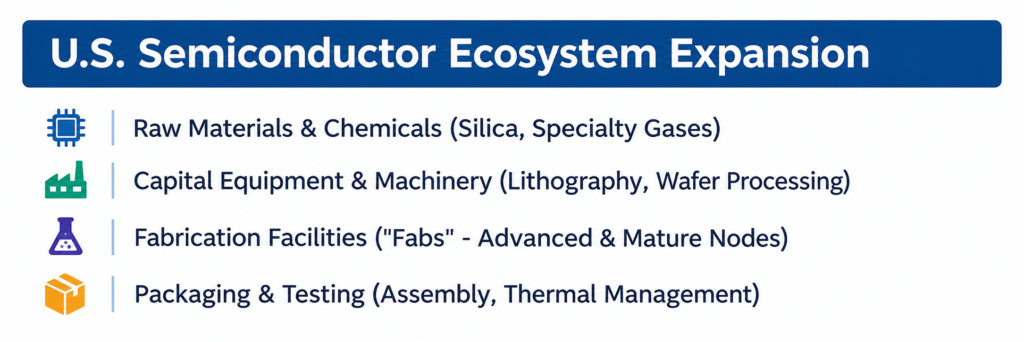
Microchips are the indispensable component of modern industry, embedded in everything from electric vehicles and medical equipment to supercomputers and national defense systems. Recognizing the structural risk of relying heavily on overseas foundries, the U.S. has made reshoring semiconductor production a national economic priority.
Key Growth Drivers
-
Federal Policy Support: Tens of billions of dollars allocated through federal manufacturing incentives have catalyzed over $500 billion in private investments across states like Arizona, Texas, Ohio, and New York.
-
Soaring Hardware Demand: The rapid expansion of AI models, automotive software, and IoT (Internet of Things) devices requires unprecedented quantities of advanced microchips.
Economic Impact and Challenges
The domestic microchip expansion generates high-paying manufacturing and engineering positions while revitalizing regional economies growth through supplier ecosystems.
The primary hurdle for domestic foundries remains workforce development. Building and operating state-of-the-art semiconductor fabrication facilities requires specialized technicians and advanced material engineers—skills currently in short supply relative to planned expansion goals.
3. Clean Energy, Grid Modernization, and Storage Systems
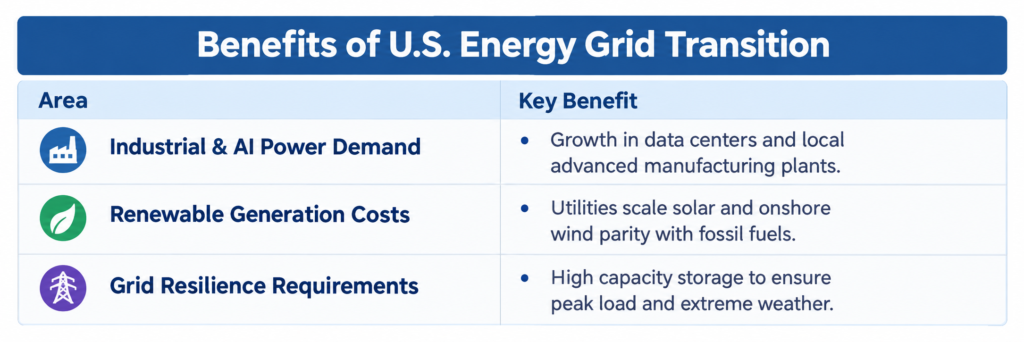
The modernization of America’s energy system is no longer driven solely by environmental targets; it is heavily fueled by energy security, grid reliability, and industrial power demands from computing and manufacturing.
Key Growth Drivers
-
Utility-Scale Storage Systems: Battery energy storage systems (BESS) are scaling rapidly, enabling utility grids to store renewable power during off-peak hours and dispatch it during peak demand.
-
Transmission Upgrades: Aging electrical infrastructure is undergoing a comprehensive overhaul to connect remote generation sites to urban consumption centers.
-
Nuclear and Alternative Baseload: Commercial interest in Small Modular Reactors (SMRs) and geothermal technology has resurged to provide carbon-free, 24/7 power for heavy industrial loads.
Economic Impact and Challenges
Energy transition project pipelines create diverse employment opportunities, from civil construction and electrical trade jobs to power systems engineering.
Grid integration delays, complex permitting processes, and supply chain constraints for critical high-voltage transformers present constant timeline challenges.
4. Advanced Manufacturing, Robotics, and Supply Chain Modernization
U.S. industrial output is experiencing a modernization drive. The combination of supply chain vulnerabilities highlighted in recent years and rising overseas shipping expenses has encouraged companies to nearshore or reshore production facilities.
Key Growth Drivers
-
Industrial Automation: Robotic automation, collaborative cobots, and computer vision systems allow domestic plants to maintain cost competitiveness while increasing safety and production precision.
-
Additive Manufacturing: 3D printing for aerospace, defense, and specialized healthcare devices drastically reduces material waste and enables localized, rapid prototyping.
-
Smart Logistics: Machine learning algorithms and automated storage/retrieval systems (ASRS) are upgrading warehouse efficiency and inventory tracking.
Economic Impact and Challenges
Modern manufacturing value-added output accounts for trillions of dollars annually in the U.S. economy. Today’s industrial jobs require high digital literacy rather than manual labor alone.
Upfront capital expenditures for industrial automation are significant, and high interest rates can temporarily delay capital allocation projects for small to medium-sized manufacturers.
5. Healthcare, Biotechnology, and Life Sciences
Demographic tailwinds provide healthcare and biotechnology with steady, structural economic growth momentum. As the U.S. population ages, demand for sophisticated medical devices, specialized pharmaceuticals, and efficient healthcare delivery systems continues to climb.

Key Growth Drivers
-
Genomic Medicine & Cell Therapy: Advances in gene editing and mRNA technology are producing targeted therapies for chronic conditions and rare genetic disorders.
-
Domestic Biomanufacturing: Federal policies encouraging domestic pharmaceutical supply resilience are driving investment in state-of-the-art biomanufacturing facilities across the country.
-
Computational Biology: Machine learning algorithms are accelerating drug discovery cycles, bringing effective treatments to market faster and at lower research costs.
Economic Impact and Challenges
The healthcare sector remains one of the largest job creation engines in the nation, offering employment at all skill levels—from clinical researchers and laboratory technicians to home health aides.
Regulatory approval timelines, clinical trial costs, and pricing pressures from healthcare payers present ongoing risks for early-stage biotechnology ventures.
Key Drivers of Long-Term Economic Resilience
The long-term success of these core sectors relies heavily on broader economic foundations:
-
Workforce Development: Aligning vocational training, community college programs, and university STEM curricula with industry needs is critical to filling open technical roles.
-
Capital Market Efficiency: Venture capital, private equity, and federal grant structures must continue providing clear pathways for early-stage innovation to reach commercial scale.
-
Infrastructure Capacity: Physical connectivity—including freight rail, deepwater ports, high-speed broadband, and stable energy supply—forms the essential foundation for industrial expansion.
The Path Ahead
The industries driving America’s next wave of economic growth represent a shift toward physical technology, energy independence, and advanced domestic manufacturing. While software innovation remains vital, the country’s mid-term growth relies heavily on building physical assets: chip fabrication facilities, modernized power grids, automated assembly plants, and advanced healthcare facilities.
By balancing technological innovation with dedicated workforce investments and sound supply chain policies, the United States is building a resilient industrial foundation capable of supporting sustainable economic expansion for decades to come.